CAREGIVER CONNECTIONS, EDUCATION AND SUPPORT ORGANIZATION (CCESO)
  • Home
  • Careworker's Manual
  • Updates
  • Activities
  • COVID-19
  • RESOURCES
  • NEWSLETTER
  • Home
  • Careworker's Manual
  • Updates
  • Activities
  • COVID-19
  • RESOURCES
  • NEWSLETTER
Search

MIGRANT CARE WORKERS ARE ORGANIZING! ADD YOUR VOICE TO OURS!

4/2/2021

0 Comments

 
Picture
Sign this petition insisting that migrant care workers deserve fairness and immigration rights.

Prime Minister Trudeau, Immigration Minister Mendicino, and my Member of Parliament,
​
Care work is the important work done to take care of children, sick and elderly in the home, often done by migrant workers. This care work is the backbone of Canada’s labour market and social support systems. Without care work, the economy doesn’t work. Canada must create a national care strategy to ensure quality care for children, the elderly and people with disabilities. Decent work and landed status now for the workers providing that care labour must be the foundation of Canada’s care economy.
Many care workers are paid low wages, work long hours and live in difficult conditions for years to have the chance to apply for permanent residency. They are tied to their employers and face exploitation as a result. Others face immense difficulty getting other jobs, particularly during COVID19. Many are unable to get PR because of language tests and educational accreditation requirements that are expensive, time consuming, and unnecessary. Migrant care workers live and work here already, requiring further proof of education or language skills is discriminatory. Care workers that have applied for permanent residency have been waiting for years to hear a decision on their application. 
We call on you to act quickly to ensure fairness. This means:
  1. Landed status now for all care workers in the country 
  2. No more waiting for PR processing
  3. No English language requirements
  4. No education accreditation requirement
  5. No more tied work permits 
  6. Reunite families
Granting landed status to care workers should be accompanied by granting full and permanent immigration status to all migrant and undocumented people in Canada now, and permanent resident status on arrival to all migrants in the future. Finally, we call on Canada to sign the ILO Convention C189 on Decent Work for Domestic Workers. 

Landed Status Now: Care Workers Organize! Members: Alberta Careworkers Association (Edmonton), Caregivers Action Centre (Toronto), CCESO – Careworker Connections and Educational Support Organization (Toronto), Committee for Domestic Workers and Caregivers Rights (Vancouver), Migrant Workers Alliance for Change (Ontario), Migrante Alberta, Migrante Canada, Migrante Ottawa, PINAY Quebec (Montreal).

Please visit : https://migrantrights.ca/take-action/landed-status-now/
​
0 Comments

Migrant Rights Network

3/31/2021

0 Comments

 
Picture


​


​55 years. Enough is enough.

Posted on March 31, 2021

Today, March 31st, is the 55th anniversary of the Seasonal Agricultural Workers Program (SAWP). Today marks over half a century of injustice, indignities and exploitation of Black and Latinx people by Canada’s agri-food industry.
This brutality has always been met with organized opposition. The first recorded wildcat strike organized by migrant farm workers was in 1967, less than a year after the program was created. 
Today hundreds of farmworker members of Migrant Workers Alliance for Change are holding simultaneous meetings at 80+ farms to light candles of resistance and make plans to fight for Full and Permanent Immigration Status for All. 
You can support this massive show of worker power by sharing a photo of your own flame of resistance posting online and tagging us on Twitter, Instagram and Facebook with #StatusforAll. Speak out today and pledge to support our upcoming four days of action in 2021. 
SAWP followed the creation of the Caribbean Domestic Workers scheme in 1955. These two programs laid the foundation for temporariness in the immigration system. Subsequent governments have only grown these programs.
Now, over 850,000 temporary study and work permits are issued in Canada each year. Most people on these programs are low-waged and racialized. We live and work here but are excluded from labour rights, healthcare, access to education and other social supports. We are separated from our families. Most of us can never get permanent residency and are forced to stay in Canada without any immigration status, and even fewer rights. 
Enough is enough. Today on the 55th anniversary of the SAWP program, we demand an end to temporariness. We demand an equal society and that means permanent immigration status for everyone.
In 2021, we are taking actions for Status for All and we need you. Join us: 
  • May 9th (Mothers’ Day)
  • June 20th (Fathers Day)
  • July 18-25 (Non-Status March from Montreal to Ottawa) 
  • September 18th (Parliament returns)
As Hady Anne for Solidarity Across Borders in Montreal said this weekend announcing the March to Ottawa: “We are not here to talk about what is possible… We are here to talk about what human dignity and justice require, what we must do to stop the destruction of the world. From 18 July to 25 July, we will take the road to Ottawa to demand Status for All. Mr. Trudeau, we are tired of waiting. We’re coming.” 
Are you with us? Go to your social media today and light your flame of resistance. 
PS: Following the murders in Atlanta of 8 people including Asian women sex workers, our member Butterfly: Asian Migrant Sex Worker project has launched #8CallsforJustice. Please sign on as an organization or individual: https://www.butterflysw.org/8callsforjustice 

Please visit :  
https://www.migrantrights.ca

0 Comments

Migrant Rights Network Sign Petition

3/29/2021

0 Comments

 
Picture


​Open Letter: Full Immigration Status for All
​

We, the undersigned, join the Migrant Rights Network in calling for full and permanent immigration status for all, without exclusions.
COVID-19 has exposed deep inequalities in our society. The fault lines are gendered and racialized: the worst impacts are being felt by women and in Indigenous, Black and Brown communities. Those most impacted have received the least support. Meanwhile, large corporations that have already accumulated immense profits receive massive bailouts.
Migrants, refugees and undocumented people have lost work and wages during the crisis but many have been shut out of emergency income supports. Those already without wages have been abandoned. They cannot pay rent, have faced starvation, lost life savings and are sacrificing essential health care.


Others have been forced to keep working in dangerous conditions. Migrant workers on farms, in greenhouses and meat and food processing plants have been hit with massive COVID-19 outbreaks. Three migrant farm workers have already died: Juan López Chaparro, Bonifacio Eugenio Romero and Rogelio Muñoz Santos. Migrant domestic workers remain trapped in the homes of their employers, facing greater surveillance, abuse and violence. Migrant students, working in low-wage jobs in warehouses and as delivery drivers, have had their tuition fees hiked to subsidize Canadian universities and colleges.
Now, as businesses reopen, those without work have little choice but to accept unsafe jobs. But conditions are the same as before — low wages and minimal labour protections. Hard-fought gains in access to healthcare remain precarious and limited. Rent hasn’t been paid and evictions are on the horizon. With mounting debt, many are facing greater exploitation but have no way to defend themselves.
An unjust immigration system is responsible. At least one in twenty-three people (over 1.6 million people) are without permanent resident status. Migrants are punished for for leaving bad employers, doing sex work, or getting sick. Access to services varies by immigration permit and is virtually non-existent for those who have been forced out of status. Lack of permanent resident status makes it difficult, and often impossible, for migrants to speak up for their rights or access services, including those they may be eligible for, because of a well-founded fear of reprisals, termination, eviction and deportation. Migrants, refugees, and undocumented people want to take care of their families and be active members of their communities. But federal immigration rules tip the scales against them.
We call for a single-tier immigration system, where everyone in the country has the same rights. All migrants, refugees and undocumented people in the country must be regularized and given full immigration status now without exception. All migrants arriving in the future must do so with full and permanent immigration status.
Full immigration status for all is necessary for global justice. COVID-19 has ravaged communities around the world, deepening economic and political crises that are being exploited by governments. Yet, Canada has closed its borders to refugees and families remain separated. Canada must support migrants and refugees here, reunite families, and ensure that no one is forced to leave their homes.
There is a global anti-racist resurgence that is sweeping the country. Violence against, and exclusion of Black communities in particular is being challenged head on. Temporary and precarious migration is racism – it excludes racialized communities from equal rights and protections. Full immigration status for all is necessary for racial justice.
Many migrants are engaged in essential work, ensuring that families and communities are cared for. Yet the majority of this work is low-waged, and the majority of those who do it are racialized and women migrants. This work is necessary not just during a public health crisis, but to transition our economies away from the impending climate catastrophe. Bad employers use immigration status as a tool to divide and pit workers against each other – citizens against non-citizens – to keep wages low and profits high. Full immigration status for all is an essential step towards eliminating inequalities in the workplace and necessary for a transition to a just and sustainable economy of care.
We are all essential. We all deserve full immigration status.
Recovery from COVID-19 calls for a rethinking of the ways in which our communities and our economy is organized. Prime Minister Trudeau: Full Immigration Status for All is just, fair, necessary and urgent. The time is now.

​visit :  https://migrantrights.ca/status-for-all/


0 Comments

Migrant Rights Network Campaign

3/25/2021

0 Comments

 
​
On March 16, 2020, as the COVID crisis was first hitting, we at the Migrant Rights Network called for healthcare, worker rights, income support, access to social services, and immigration status for migrant and undocumented people. 


12 months later, we look back and we look ahead. With you, we vow to keep organizing and fighting for full and permanent immigration status for all.


(1) HEALTHCARE FOR ALL: As COVID-19 raged through 2020, migrants won policies in many provinces to ensure access to healthcare and COVID testing. But in many places these policies are not being implemented and migrants continue to be turned away or charged high fees for life-saving care. Today, we are calling on all provinces and the federal government to put in place concrete measures to ensure safe and dignified access without fear to COVID19 vaccinations.


(2) WORKER PROTECTIONS & INCOME SUPPORTS: As a result of our work, the Canada Emergency Response Benefit (CERB) was extended to migrants, a valid Social Insurance Number was made mandatory part way through 2020 to qualify for the Canada Recovery Benefit (CRB). Now with tax season approaching, many migrants are scared of a clawback they cannot afford. We demand a CERB/CRB amnesty.


Without income support, migrant people either faced starvation and eviction, or were forced to work in dangerous and sometimes deadly conditions. Farmworkers, care workers, delivery workers, cleaners and other low-wage workers are called ‘essential’ even as we are excluded from essential rights and protections. But we take care of us: Migrants fundraised, set up mutual aid networks and stepped in when governments failed us. Migrants stood up against bad bosses, organized strikes and raised our voices. We will continue to organize for justice and equality.

(3) STATUS FOR ALL: Fundamentally, a fair society with equal rights for all requires that everyone have the same immigration status. This is why migrants organized over 30 rallies, protests and marches calling for Full & Permanent Immigration Status for All.


In early 2020, the federal government announced a moratorium on deportations because of the pandemic. But the callous practice of deportation continues: by the end of 2020, Canada had deported more people in 2020 than in the previous 5 years. Just this week, a man who contracted COVID while in immigrartion detention was deported despite showing symptoms. Throughout, migrants organized in detention centers, and in Quebec, many secured their own release. Migrant student workers denounced government policies that punished them for the pandemic by letting their permits run out. They won new work permits, a one-time stopgap to the deportation of 52,000 people. But immigration rules continue to exclude low-waged working class people, particularly undocumented workers and those on employer controlled indentureship permits.

(4) SOCIAL SUPPORTS: While some federal, provincial and municipal supports went towards emergency food boxes, it was primarily donations from people like you that allowed migrant groups to feed communities without work. Poor and working class migrants were only able to ward off evictions, get healthcare, childcare or social supports when we united with our neighbours and co-workers to offer real solidarity in the face of deadly policies.

A year into this pandemic, let us re-commit to building a different future together. Talk to your neighbours, friends and co-workers. Raise your voice. Echo and amplify the demands of migrant and undocumented people. Let us build a just world for all of us.
 
Migrant Rights Network


Migrant Rights Network is Canada’s only cross-country coalition of migrant led organizations and allies with migrant and undocumented membership from coast to coast.


PS: Read and share this post from our website with links: https://migrantrights.ca/march182020/

 Follow us on facebook, twitter & instagram and ask your friends to sign on at www.MigrantRights.ca

 
Migrant Rights Network does not take funding from political parties or corporations - chip in to support our work!
0 Comments

Public policy extended for temporary residents applying to restore status

3/25/2021

0 Comments

 
Ottawa, December 31, 2020--Effective January 1, 2021, Immigration, Refugees and Citizenship Canada is renewing a temporary public policy that provides more time for temporary residents to apply to restore their legal status in Canada.
This public policy, which has been in place since July 2020 but was set to expire, recognizes that many temporary residents in Canada have been affected by worldwide health- and travel-related restrictions, and may need to remain in Canada for longer than they anticipated.
Under the public policy, visitors, students and workers whose valid temporary status expired, or expires, between January 30, 2020, and May 31, 2021, will have until August 31, 2021, to restore their status. In addition, the public policy will continue to allow former work permit holders applying for an employer-specific work permit to work while a decision on their restoration application is pending..

​For more info please visit : https://www.canada.ca/en/immigration-refugees-citizenship/news/notices/public-policy-extended-restore-status.html?fbclid=IwAR 

0 Comments

Employment Insurance and the Canada Recovery Benefit

1/4/2021

0 Comments


New recovery benefits
The new recovery benefits are available between September 27, 2020, and September 25, 2021.


To give Canadians seeking employment the support they need to get back on their feet, the government has made changes to the Employment Insurance (EI) program.
EI is now available to more Canadians, including those who would not have qualified for EI in the past, extending coverage to more than 400,000 people. Anyone receiving EI is eligible for a taxable benefit rate of at least $400 per week, or $240 per week for extended parental benefits, and regular benefits are accessible for a minimum duration of 26 weeks.
Additionally, to ensure that Canadians receive the support they need during these challenging times, 3 new benefits have been implemented:
  • The Canada Recovery Benefit (CRB) will provide $400 per week, for up to 26 weeks, to workers who are self-employed or are not eligible for EI and who still require income support and are available and looking for work. This benefit will support anyone residing and present in Canada whose income has dropped or not resumed due to COVID-19.
  • The Canada Recovery Sickness Benefit (CRSB) will provide $500 per week, for up to 2 weeks, for workers who are sick or must self-isolate for reasons related to COVID-19.
  • The Canada Recovery Caregiving Benefit (CRCB) will provide $500 per week for up to 26 weeks per household for eligible Canadians unable to work because they must care for
    • a child under age 12, due to school or daycare closures because of COVID-19
    • a family member with a disability, or a dependant, because their day program or care facility is closed due to COVID-19, or
    • a child, a family member with a disability, or a dependant who is not attending school, daycare or any other care facility upon the advice of a medical professional due to being at high risk if they contract COVID-19
Transition from Canada Emergency Response Benefit to Employment Insurance The Government of Canada has announced changes to EI, and new recovery benefits that will better support Canadians.
If you need financial assistance after your CERB ends As of September 27, 2020, there are some temporary changes to the EI program to help you access EI benefits. These changes will be in effect for 1 year.
Find out if you qualify
If you received the CERB through Service Canada After you receive your last CERB payment, continue completing reports. In most cases, you do not need to apply for EI benefits. We'll automatically review your file and your Record of Employment, then start a claim for EI regular benefits if you qualify. If you do not qualify, you will be notified by mail.
You will need to apply for EI after your CERB ends if
  • you have a social insurance number that starts with a 9
  • you are self-employed, or
  • you declared that you returned to work full-time on your CERB report
If you need sickness benefits instead of regular benefits You can declare on your reports that you are unable to work for medical reasons, and you could receive up to 15 weeks of sickness benefits.
If you received the CERB through the Canada Revenue Agency You need to receive all your CERB payments before applying for EI benefits. You can apply after the end of your last CERB eligibility period. Visit EI benefits and leave to determine which benefit is right for your situation and to apply online.
Apply for Employment Insurance
Canada Recovery Benefit The Canada Recovery Benefit (CRB) gives income support to employed and self-employed individuals who are directly affected by COVID-19 and are not entitled to Employment Insurance (EI) benefits. The CRB is administered by the Canada Revenue Agency.
If you are eligible for the CRB, you can receive $1,000 ($900 after taxes withheld) for a 2-week period.
If your situation continues past 2 weeks, you need to apply again. You may apply for up to a total of 13 eligibility periods (26 weeks) between September 27, 2020, and September 25, 2021.
For more information, go to Canada Recovery Benefit.

Canada Recovery Benefit:
Frequently asked questions
Read this section in another language Make your selection...لْعَرَبِيَّةُ (PDF, 218KB)فارسی (PDF, 186KB)Italiano (PDF, 78KB)한국어 (PDF, 244KB)Português (PDF, 80KB)ਪੰਜਾਬੀ (PDF, 338KB)简化字 (PDF, 152KB)Español (PDF, 77KB)正體字 (PDF, 286KB)Tiếng Việt (PDF, 199KB)
Who is eligible for the Canada Recovery Benefit? 
The Canada Recovery Benefit (CRB) is available to anyone who is residing and present in Canada for the 2 weeks for which they are applying for the CRB, and
  • was at least 15 years of age on the first day of the period
  • has a valid social insurance number
  • had a total income of at least $5,000 for 2019, 2020 or in the 12-month period preceding the day on which they make their first application for the CRB, from one or more of the following sources:
    • employment income
    • self-employment income, or
    • Employment Insurance (EI) maternity or parental benefits or Quebec Parental Insurance Plan benefits
  • meets one of the following conditions for the period for which they are applying:
    • stopped work for reasons related to COVID-19, or
    • had a reduction of at least 50% in their employment income or self-employment income for reasons related to COVID-19,
  • was seeking work during the period for which they are applying
  • did not place undue restrictions on their availability for work on or after September 27, 2020, unless reasonable to do so
  • did not quit their employment or voluntarily ceased to work on or after September 27, 2020
  • did not
    • fail to return to their employment when it was reasonable to do so, if their employer so requested
    • fail to resume self-employment when it was reasonable to do so, or
    • decline a reasonable offer to work that would have started during the 2-week period
  • was ineligible for EI benefits
  • was not in receipt of the Canada Recovery Caregiving Benefit, the Canada Recovery Sickness Benefit, short-term disability benefits, workers’ compensation benefits, any EI benefits, or Quebec Parental Insurance Plan benefits.
Individuals must apply after every 2-week period for which they are seeking income support, and must attest that they continue to meet the requirements.
To encourage people to work, beneficiaries may earn income from employment and/or self-employment while receiving the CRB, as long as they continue to meet the other requirements.
However, to ensure that the CRB helps those who need it most, beneficiaries will need to repay through their income tax return $0.50 of the benefit they receive, for every dollar of net income earned above an annual net income of $38,000 (excluding the amount received for the CRB), up to the total of the CRB they received in a calendar year. Amounts repaid will not be included in taxable income.
Can I receive the Canada Recovery Benefit if I’m not a citizen or a permanent resident? 
Yes, as long as you are residing and present in Canada during the period for which you are claiming the benefits and meet the other eligibility criteria.
When can I access the Canada Recovery Benefit? 
Unlike the Canada Emergency Response Benefit and the Canada Emergency Student Benefit, the Canada Recovery Benefit (CRB) payment is retroactive. This means you
  • you can only apply for the CRB after the period for which you’re applying has ended, and
  • you must apply within 60 days after the period for which you’re applying has ended
How do I apply for the Canada Recovery Benefit?
The best way to apply for any of the recovery benefits is online, via My Account. However, anyone who does not have access to the Internet can apply using the CRA’s automated toll-free phone lines: 1-800-959-2019 or 1-800-959-2041.
To obtain further information on how to apply for the Canada Recovery Benefit visit the transitioning to new benefits Web page.
Can I receive more than one of the recovery benefits between September 27, 2020, and September 25, 2021? 
Yes, as long as you meet the applicable eligibility criteria. 
However, you cannot claim more than one of the recovery benefits for a given period. 
Also, you may not receive any of the recovery benefits if you are receiving Employment Insurance benefits, provincial maternity or parental benefits, or any other paid leave for the same period.
Can I access any Employment Insurance benefits while receiving the Canada Recovery Benefits? 
No.  You may not receive any of the recovery benefits at the same time you are receiving any Employment Insurance Benefits, provincial maternity or parental benefits, or any other paid leave.
Once I receive my first payment, can I assume that I will continue to receive my next payments without doing anything?
 No, the payments will not continue automatically.
A new application must be submitted for each eligibility period because you must attest that you were unable to work.
How will you decide my tax rate? The Canada Revenue Agency will apply a flat 10% deduction at source for all of the recovery benefits.
How do I know whether to apply for Employment Insurance benefits or the Canada Recovery Benefit? 
If you’ve paid Employment Insurance (EI) premiums as an employee, and have at least 120 hours of insurable employment, you are likely eligible for EI benefits and should apply.
If you don’t have the minimum number of hours needed for an EI claim, you may be eligible to receive the Canada Recovery Benefit if you meet the eligibility criteria.
For how many weeks can I receive the Canada Recovery Benefit? 
You can receive the Canada Recovery Benefit for up to 26 weeks between September 27, 2020, and September 25, 2021.
I was receiving the Canada Emergency Response Benefit until the end of June and then found employment but, although still employed, I am being asked by my employer to work reduced hours. 
Am I eligible for the Canada Recovery Benefit? 
You may be eligible for the Canada Recovery Benefit if you have suffered a reduction in income of 50% or more due to COVID-19 and you meet all of the other eligibility criteria.
What constitutes a reduction in income when compared to pre-COVID times? Does a $1 reduction count? 
​To be eligible for the Canada Recovery Benefit while still working, you must have suffered a reduction in average weekly income of at least 50% relative to pre-pandemic levels.
A reduction in income is defined as a reduction in total average employment and self-employment income for the 2-week benefit period compared to your average employment income for a 2-week period the previous year.
To calculate your reduction in average income
  • use your annual net income for 2019 or 2020, or the 12-month period prior to your application, and
  • divide it by 26 to determine your average earnings for a 2-week period
For example, Deborah had net income of $39,000 in 2019. To determine her average earnings for a 2-week period prior to the pandemic, Deborah divides this amount by 26, producing $1,500. Because Deborah is currently earning only $700 every 2 weeks, she has suffered an income reduction of more than 50%, and is eligible to claim the Canada Recovery Benefit.
I’m a seasonal worker. I wasn’t able to work my usual number of hours because of the pandemic, so I do not qualify for Employment Insurance. Am I eligible for the Canada Recovery Benefit? If you are not eligible for Employment Insurance, but are unable to work or are working reduced hours due to COVID-19, you could be eligible to receive the Canada Recovery Benefit, as long as you meet all of the other eligibility criteria.
This includes having earned at least $5,000 from employment or self-employment in the previous calendar year, or the 12 months prior to your first application for the Canada Recovery Benefit. You must also be unable to work, or have suffered an income reduction of 50% or more due to COVID-19.
I entered the labour force late in 2019 so was not able to earn $5,000, but I would have been able to earn that much in 2020 if I hadn’t lost my job due to COVID. Do I qualify for the Canada Recovery Benefit? No.
To be eligible to receive the Canada Recovery Benefit, you must have had employment and/or self-employment income of at least $5,000 in 2019 or in 2020, or in the 12-month period prior to your first application for the CRB.
If I’m paid income after applying for the Canada Recovery Benefit for work done before I applied, does it impact my ability to get the benefit?  You may earn income from employment and/or self-employment while receiving the Canada Recovery Benefit (CRB) as long as you continue to meet the other requirements. This includes earning 50% or less of your previous income for a 2-week period due to COVID-19.
However, you will be required to repay $0.50 of the CRB for every dollar in net income you earn above $38,000 for the year (excluding the CRB amount received). This would include amounts you earned in the year prior to applying for the CRB.
What constitutes the $38,000 in net income I am allowed to earn before I become subject to the repayment requirement?You are allowed to earn up to $38,000 in net income (excluding the Canada Recovery Benefit amount received) before becoming subject to the repayment provision. 
What happens if I have net income over $38,000 in the tax year? How will the Canada Recovery Benefits be returned? If you receive the Canada Recovery Benefit (CRB), you’ll need to repay some or all of the benefit CRB through your income tax return if your annual net income, excluding the CRB payment, is more than $38,000.
In other words, you’d need to repay $0.50 of the CRB for each dollar of your annual net income above $38,000 in the calendar year, to a maximum of the amount of benefit you received.
This will be reconciled when you file your taxes for that calendar year.
Canada Recovery Sickness Benefit Read this section in another language Make your selection...لْعَرَبِيَّةُ (PDF, 111KB)فارسی (PDF, 104KB) Italiano (PDF, 42KB)한국어 (PDF, 184KB)Português (PDF, 44KB)ਪੰਜਾਬੀ (PDF, 242KB)简化字 (PDF, 104KB)Español (PDF, 42KB)正體字 (PDF, 190KB)Tiếng Việt (PDF, 152KB)The Canada Recovery Sickness Benefit (CRSB) gives income support to employed and self-employed individuals who are unable to work because they are sick or need to self-isolate due to COVID-19, or have an underlying health condition that puts them at greater risk of getting COVID-19. The CRSB is administered by the Canada Revenue Agency.
If you are eligible for the CRSB, you can receive $500 ($450 after taxes withheld) for a 1-week period.
If your situation continues past 1 week, you will need to apply again. You may apply for up to a total of 2 weeks between September 27, 2020, and September 25, 2021.
For more information, go to Canada Recovery Sickness Benefit.
Canada Recovery Caregiving Benefit Read this section in another language Make your selection...لْعَرَبِيَّةُ (PDF, 107KB)فارسی (PDF, 106KB) Italiano (PDF, 42KB)한국어 (PDF, 186KB) Português (PDF, 43KB)ਪੰਜਾਬੀ (PDF, 247KB)简化字 (PDF, 86KB)Español (PDF, 43KB)正體字 (PDF, 179KB)Tiếng Việt (PDF, 116KB)The Canada Recovery Caregiving Benefit (CRCB) gives income support to employed and self-employed individuals who are unable to work because they must care for their child under age 12, or a family member who needs supervised care.
This applies if their school, regular program or facility is closed or unavailable to them due to COVID-19, or because they are sick, self-isolating, or at risk of serious health complications due to COVID-19. The CRCB is administered by the Canada Revenue Agency.
If you are eligible for the CRCB, your household can receive $500 ($450 after taxes withheld) for each 1-week period.
If your situation continues past 1 week, you will need to apply again. You may apply for up to a total of 26 weeks between September 27, 2020, and September 25, 2021.
For more information, go to Canada Recovery Caregiving Benefit.
How financial benefits affect family sponsorship If you collect the Canada Emergency Response Benefit (CERB), you are still eligible to sponsor your spouse, parent, grandparent, child or other relative as long as you meet all of the requirements to be a sponsor.
The CERB is not considered social assistance. Collecting the CERB will not make you ineligible to sponsor.
Employment Insurance and the CERB will not cause you to default If the person you sponsored collects Employment Insurance or the CERB during the undertaking period, it will not cause you to default.
However, if the person you sponsored collects social assistance during the undertaking period, you have to repay the amount. If you do not, you will be in default of your undertaking.

Please visit :
https://www.canada.ca/en/immigration-refugees-citizenship/services/coronavirus-covid19/financial-assistance.html 
0 Comments

Permanent residence for Caregivers (Updates on Applications)

11/15/2020


Home Child Care Provider Pilot and Home Support Worker Pilot

Government of Canada:
​"We’ve received at least 2,750 applications under the Home Child Care Provider pilot. Because of this
  • the pilot is closed to new applications for 2020
  • we’ll return any other applications we received and refund the fees
The pilot will reopen on January 1, 2021.
​
We’re not close to reaching the cap for the Home Support Worker Pilot. You can still apply under this pilot. We’ll update this page if and when we close that pilot to new applications for 2020.
For now, you don’t need to contact us about an application you submitted in 2020 under either pilot. We’re still in the process of opening applications now that our offices are open again.

If we accept your application into processing for 2020, we’ll send you a notification letter. Due to the COVID-19 pandemic, it may take longer than usual for you to get the letter."

Behind Closed Doors

11/2/2020


EXPOSING MIGRANT CARE WORKER EXPLOITATION DURING COVID- 19

​As many regions continue into the second wave of the pandemic, the conditions outlined in this report are reoccurring or worsening right now. The cumulative and cascading crises of COVID-19 demand an immediate response through policy changes that will ensure rights and protections for migrant care workers. The most crucial of these changes is full and permanent immigration status for all migrant care workers in Canada now, and full and permanent immigration status for all migrant care workers that arrive in the future. This will give migrants the ability to protect themselves against labour exploitation, ensure access to emergency income supports and universal healthcare, and reunite families. A fair society is only possible with equal rights for all, and equal rights for all are only possible if everyone in the country has the same immigration status. Further recommendations are outlined at the end of this report.

Table of Contents:

Who we are
Acknowledgements
Contact
SECTION 1: INTRODUCTION
Stolen Hope: COVID-19 and the Cascade of Crises Experienced by Migrant Care Workers
Summary of Findings
SECTION 2: CANADIAN LAWS THAT CREATE MIGRANT CARE WORKER EXPLOITATION
Care Worker Immigration Programs in Summary
SECTION 3: EXPOSING THE EXPLOITATION OF MIGRANT CARE WORKERS DURING COVID-19
CHAPTER 1: STOLEN LABOUR: WORK AND INCOME DURING COVID-19
  • Labour intensification
  • Unpaid wages
  • Difficulty enforcing rights
  • Lost work and limited access to income supports
  • Difficulty finding work during COVID-19
CHAPTER 2: STOLEN HOPE: DELAYS IN PERMANENT RESIDENCY AND APPLICATION PROCESSING
  • Fear of not finishing 24 month work requirement
  • Difficulty meeting language and educational requirements
  • Difficulties and delays in permit processing
CHAPTER 3: FREEDOM DENIED
  • Control over housing and movement
  • Barred from public transportation
CHAPTER 4: UNSTABLE HOUSING IN A PANDEMIC
CHAPTER 5: STOLEN TIME: FAMILY SEPARATION AND IMPACT ON CHILDREN
CHAPTER 6: STOLEN HEALTH: HEALTH IMPACTS AND ACCESS TO SERVICES
  • Lack of sick leave
  • Difficulty accessing medical care
SECTION 4: RECOMMENDATIONS
The Change Migrant Care Workers Need Right Now!
  • Full and Permanent Immigration Status for All & Landed Status Now
  • Interim Measures to Ensure Rights for Migrant Care Workers
  • Real access to PR: Reinstate the Interim Pathway with modifications
  • Open Work Permits for Migrant Care Workers
  • Labour Rights and Income Support
  • Healthcare for All
  • Ensure Family Unity
  • Housing
  • Federal Workers Program (FWP) – Care Worker Stream
Click here to read the Survey Report: BEHIND CLOSED DOORS

Care workers calling on the Federal government for FULL and PERMANENT immigration #StatusForAll!

10/31/2020


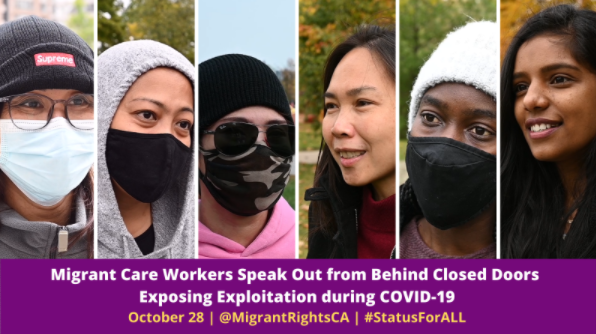
Behind Closed Doors: Exposing Migrant Care Worker Exploitation During COVID-19
Picture
Migrant care workers across Canada released a report and this video on Oct 28 to share stories of abuse and their call for change.
These are Care Workers like you speaking out about their experiences! As Care Worker Leader Mariyah says,
"Let’s come out with care workers so we can have a strong voice to push the government for our rights to getting our immigration status and bringing our families! "
Watch, read and take action when we launch: www.MigrantRights.ca/BehindClosedDoors.

JOIN US FOR A DAY OF ACTION FOR STATUS FOR ALL ON NOVEMBER 1st:  https://www.facebook.com/events/1025481547913684

ADD YOUR VOICE: www.StatusforAll.ca

--
Authored by Caregivers Action Centre (CAC), Vancouver Committee for Domestic Worker and Caregiver Rights (VCDWCR), Caregiver Connection Education and Support Organization (CCESO), and Migrant Workers Alliance for Change (MWAC), the report is endorsed by Alberta Careworkers Association, PINAY Quebec, Migrante Canada, Migrante Alberta, and Association for the Rights of Household and Farm Workers (ADDPD/ARHW). A joint project of the Landed Status Now Working Group of Migrant Rights Network.
Watch Video Here

UPDATES on CERB

10/23/2020


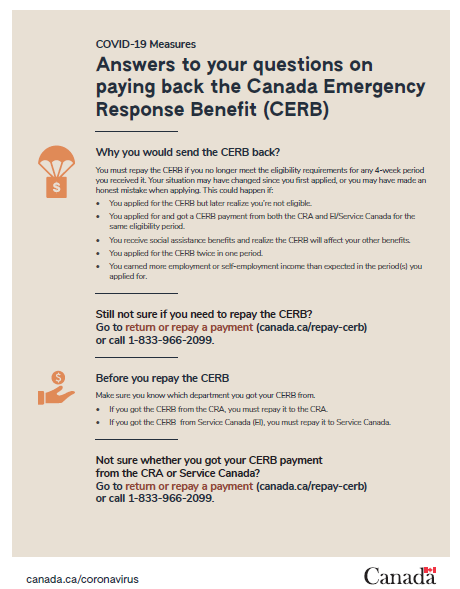
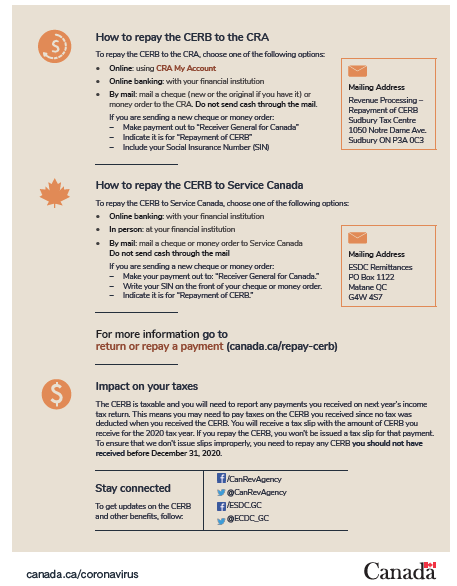
​ Answers to your questions on paying back the Canada Emergency Response Benefit

The Canada Emergency Response Benefit, or CERB, was the financial support to employed and self-employed Canadians who were directly affected by COVID-19. The CRA has set the CERB benefit period between March 15 and September 26. Your benefit ends when you have received 28 weeks of benefits or on October 3, 2020, whichever comes first. For those who applied through the Canada Revenue Agency, the last four-week period for the CERB was August 30, 2020 through September 26, 2020. 

If you are one of the recipients of this benefit, and you are not sure if you need to return or repay the CERB you received, here's what to do next.
Click Here: Return or Repay a Payment
Picture
Picture

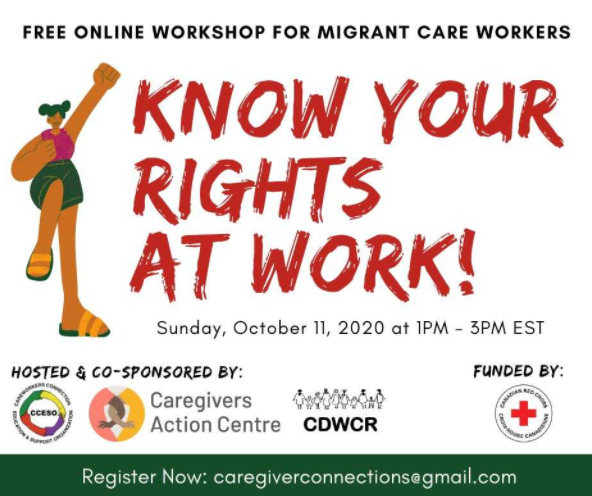
FREE Online Workshop for Migrant Workers

10/16/2020


Know Your Rights at Work!

CCESO held a FREE online workshop last October 11, 2020. Some of the questions asked by our fellow Care workers are listed below, and were answered by our hosts.
Picture
Workshop Questions
 
EMPLOYMENT RIGHTS
  1. I am still working for my employer, but because of the crisis, I am now working long hours and I am not being paid overtime or for all of the hours I’m working. I am very lucky to still have my job, but I’m scared if I tell my employer about my rights, I will be laid off. What can I do? 
  2. My employer is threatening me that if I leave the house to buy groceries or go for a walk, I will be fired. I have been locked up in their house for months. What are my rights in this situation? Why can my employer leave the house, but I can’t? 
  3. I want to leave my employer because I am working long hours with only 1 day off. My employer is very demanding and sometimes even the children are verbally abusive. I have been in this job since Sept 2019 and my work permit will expire on Aug 2021. My health is deteriorating but I'm afraid to resign. What should I do?
  4. If my employer is mistreating me, what should I do? (i.e. document everything!)
    1. Explain the different areas of abuse (i.e. financial, 
  5. Do I have access to sick days or emergency leave? 
  6. My employer fired me during COVID-19, what are my rights?
  7. Is it legal for the employer to pay our overtime hours with rest days/hours instead of money? What should we do if they are demanding this?
  8. I work for a close relative  and she said that our contract is only on paper so she does not pay me regularly. Is this legal? I want to leave because they treat me like a maid
  1.  My employer was away for two weeks and I was left alone in the house. They say that was already considered my vacation because I was not doing child care for the children. Am I still entitled for a vacation pay if I want to go away?
INCOME SUPPORTS 
  1. Can I get income support if I am laid off due to COVID-19? (i.e. new Canada Response Benefit). What income support can I access now that CERB is over? 
  2. My employer reduced my salary, but not my hours of work. They forced me to collect CERB even though I am still working full-time hours for them. Is this right?
MINIMUM WAGE
  1. If I am receiving minimum wage, should my wages go up after October 1st?

What is the Anti-Terror Bill?

6/24/2020

 
Picture
What is the Anti-Terror Bill?

Caregiver Connections Education & Support Organization (CCESO) invites you to a free webinar on Saturday, June 27, 2020 at 8:00 PM EST (5:00 PM PST).

The title of the "Anti-Terror Bill" alone does not tell us what it really means. This is why we made an effort to invite the prominent Filipino Human Rights lawyer, educator, and advocate, Atty. Jose Manuel "Chel" Icasiano Diokno, J.D. to discuss it with us.

He serves as chairman of the Free Legal Assistance Group (FLAG) and the founding dean of the De La Salle University College of Law. He also served as special counsel of the Senate Blue Ribbon Committee.

We are hoping that you would join us in our attempt to understand thoroughly the underlying effects and consequences of this fundamental issue in the lives of our friends and family back home.

To RSVP: please contact Marlyn or Juli

Care Work Stories

6/3/2020

 
Picture
CARE WORK STORIES: DIGITAL EDITION
SUNDAY JUNE 21, 2020
2:00 PM - 3:15 PM EST


A discussion with Filipino Care Workers and allies to explore their long history fighting for (and winning) human rights in Canada. Register online at https://rb.gy/nsujtc

Migrant Care Workers are more than the "care" they provide to children, the elderly and our most vulnerable family members. Their stories are complex and as varied as the people who live them - past and present.

Kwentong Bayan Collective hosts a discussion with Filipino Care Workers and allies to explore their long history fighting for (and winning) human rights in Canada. We will learn about the recent movement that boldly calls for "Full Immigration Status for All".

We will meet artists who support migrant communities to tell their stories. And listen to the personal stories of Migrant Care Workers whose labour is currently keeping communities safe during COVID-19.


Read More

Migrant Rights Network - June 14, 2020

5/31/2020

 
Picture
On June 14th join the Migrant Rights Network as they launch a campaign by over 40 migrant-led and allied organizations for full immigration status for all: www.MigrantRights.ca/June2020

Join a massive digital and social media gathering of migrants, poor and working class people, and allies. The global COVID-19 pandemic has proven that migrants are essential to our communities, but are exploited and excluded. Together, migrants from across Canada will raise our voice for healthcare, decent work, family unity and equal rights for all.

Actions will take place all day on social media and in the streets, learn more and get involved: https://migrantrights.ca/june2020

Digital Literacy for Migrant Workers

2/26/2020

 
Picture
  • IntersectTO - a BIPOC tech community is partnering with Caregiver Connections, Education and Support Organization (CCESO) and Parkdale Project Read to offer a free Digital Literacy Drop-in session for Migrant Care Workers / Caregivers.

  • DATE: Sunday March 15, 2020
  • Registration: 12:00-12:30 PM
  • Drop-in Sessions: 12:30 - 4:00 PM

  • LOCATION: Parkdale Project Read, 1209 King St. West (Southeast corner of Dufferin & King) in between the Subway restaurant and Eye Care centre.

  • ABOUT THE EVENT:
  • Volunteers from IntersectTO will provide free tech support and answer questions. Please bring your devices!


Migrant Care Workers/Caregivers have expressed interest in learning about:

* Smartphones - apps, changing settings, security issues and other troubleshooting issues

* How to write resume on Word or alternative free doc programs

* Staying safe online and on social media

* Setting up basic websites and designing flyers

* Using collaborative applications

* Connecting Bluetooth devices

* Uploading media to the cloud like photos or contact information

* How to locate your phone if it gets lost

* Laptop support - updating your OS, accessing VPN, anti-virus support
We’ll cover these topics and more!

This free event is designed for the Migrant Care Workers / Caregiver community. Registration is required. For more information, contact CCESO.

ACCESS INFO: Parkdale Project Read is accessible to people using wheelchairs, scooters, and other mobility devices. Front door equipped with access ramp and power-assist button. No stairs. Gender-inclusive and accessible bathroom is equipped with assist bar. Please come scent/fragrance free.

Light Refreshments provided. On-site child minding support available.
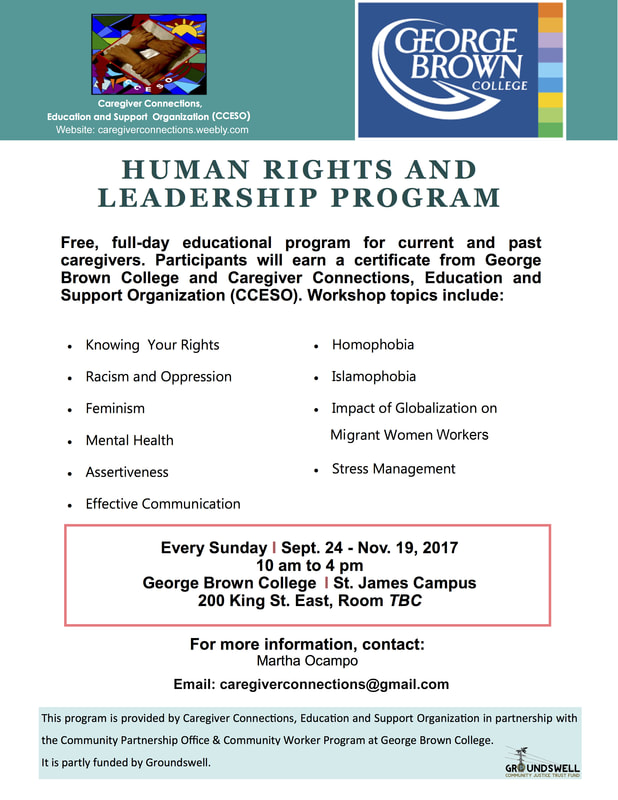
Human Rights & Leadership Program 2019

9/1/2019

 
Caregiver Connections, Education & Support Organization (CCESO) presents:
Human Rights and Leadership Program 2019

A FREE full-day education program for current and past Caregivers
Workshop topics include:
  • Knowing Your Rights
  • Racism & Oppression
  • Feminism
  • Mental Health
  • Assertiveness
  • Effective Communication
  • Violence Against Women
  • Gender, Power & Privilege
  • Impact of Globalization on Migrant Women
  • Stress Management
  • Advocacy
  • Changes to the Caregiver Program
  • Introduction to Storytelling

Every Sunday  - September 29 to December 1, 2019 from 10 am to 4 pm at George Brown College, St. James Campus, 200 King St. East, Room to be confirmed.

Contact Martha Ocampo for registration and more info

This free educational program is offered by CCESO in partnership with the Community Partnership Office & Community Worker Program at George Brown College and Parkdale Project Read. Participants will earn a certificate from GBC and CCESO.
Picture

Picnic in the Park 2019

7/14/2019

 
Please join CCESO for our annual summer picnic in the park with fun and games, BBQ and refreshments, and social time with our community.

Saturday August 10, 2019
Meet us at 10 am
at Wilket Creek Park
1100 Leslie St., North York

Free event, all are  welcome!
Picture

Unite Against Racism - Migrant Rights Network

6/17/2019

 
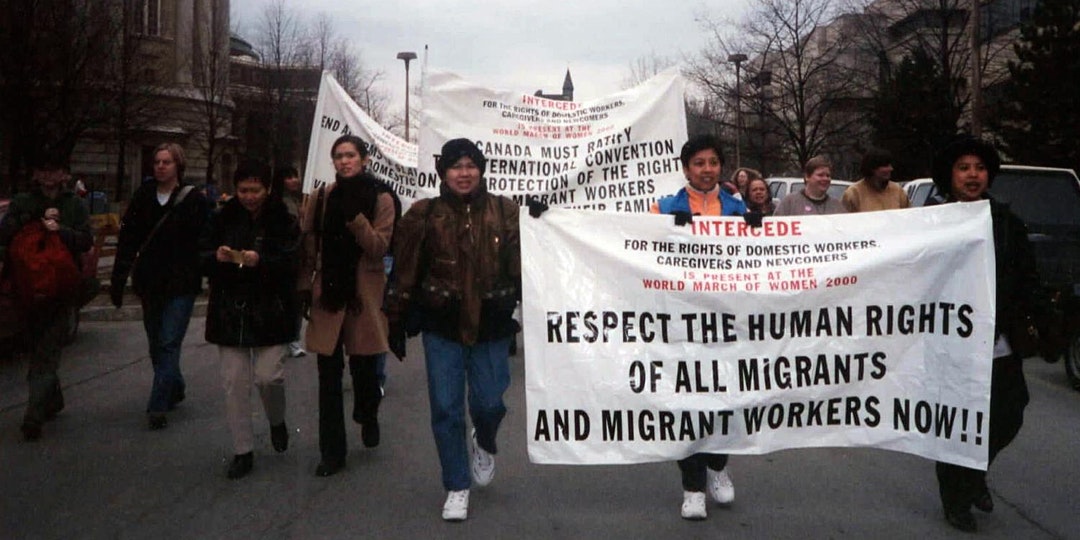
Hundreds of people marched to Unite Against Racism on June 16, 2019.

Members of the Migrant Rights Network are taking actions across the country to oppose racism, to ensure immigrant justice and to build a people’s movement for change.

We will #UniteAgainstRacism.
We need #MigrantJusticeNow
Picture
Caregiver Connections Education & Support Organization (CCESO) at the front of the Unite Against Racism march with their handsewn banner

March 10, 2019 - Re-Imagining Stories of Care Work

3/2/2019

 
Picture
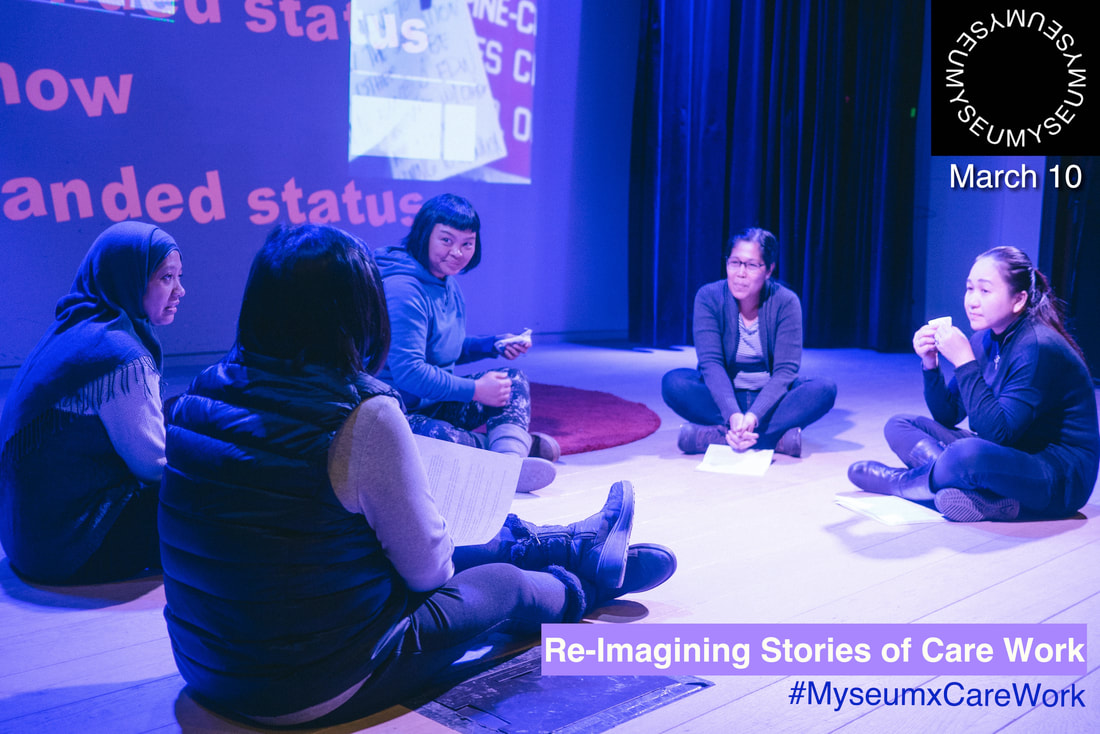
Image: Storytellers: Bong, Cristina, Cecil and Gladys in rehearsal with our facilitator, Karen Ancheta. Photo by Eloisa Guerrero.
Please join us for Re-Imagining Stories of Care Work - a collaborative storytelling and audio-visual art performance about the invaluable contributions of migrant caregivers to Canada’s social, economic, and political past, present and future.

Collaborative storytelling by Caregiver Connections, Education & Support Organization (CCESO) and audio-visual art performance by Kwentong Bayan Collective. With support from Karen Ancheta, Storyteller/Facilitator and Leon Aureaus, Artistic Director, Carlos Bulosan Theatre. Presented by the Myseum Intersections Festival.

When:
Sunday March 10, 2019
Stories of Care Work Performance: 1-3 PM
Stories of Care Work Reception: 3-4 PM

Where:
Spadina Theatre
24 Spadina Rd, Toronto, ON M5R 2S7
Closest Accessible subway is SPADINA.

Admission:
FREE EVENT. Donations accepted.

Limited seating, please RSVP via Eventbrite:
<https://www.eventbrite.ca/e/myseum-intersections-re-imagining-stories-of-care-work-performance-tickets-55431960486>

Access info:
Barrier free venue with seating area available for people in wheelchairs or with disabilities upon request. Washrooms are accessible. If you have any additional requirements or need additional assistance, please email Myseum at: [email protected] and we will do our best to accommodate.

By subway:
From Spadina Station. Go north on Spadina Road to the next intersection on Lowther Avenue. Spadina Theatre is on the west side of the street. Use lower entrance with wheelchair access ramp.

Parking:
There are several public parking lots close by, including:
Green P Parking, Carpark 231, at 19 Spadina Road and on-street parking all around.

Re-Imagining Stories of Care Work is part of Myseum Intersections, an annual festival that explores intersectional perspectives of Toronto through FREE collaborative exhibits, events, workshops, and tours.

Check out the full program at: http://www.myseumoftoronto.com/program/myseum-intersections/
Please note that there will be photography taken at this event.

CCESO Bus Trip 2019

3/2/2019

 
Picture
Caregiver Connections, Education and Support Organization (CCESO) presents:

Ottawa-Montreal-Quebec City
3-day Tour

on May 18, 19, & 20, 2019
Long weekend (Victoria Day)

Itinerary:
Day 1: Toronto-Kingston - Ottawa: Parliament Hill - Civilization Museum. Montreal: Dinner - Hotel Accommodation: SANDMAN or similar

Day 2: St. Josephy Oratory - Norte Dame Basilica - Olympic Stadium (Montreal Tower) - Montreal (Lunch) - Quebec: Old Quebec City Sightseeing. Hotel Accommmodation: UNIVERSEL or similar

Day 3: Quebec City - Brunch - Thousand Islands Boat Cruise - Toronto

Limited Seats! Reserve NOW!!!

Price: Adult/Child $260 - Quad Sharing, $325 - Double Sharing. Inclusive of transportation, 2-night hotel accommodation & gratuities.

Please note that a 50% down payment is required to reserve a seat. Full payment should be given on or before April 30, 2019. For more information & payment arrangement, please contact CCESO.

NOT INCLUDED:
1. Admission to show tickets
2. All personal expenses
3. Admission fees to: (optional)
- Canadian Museum of History (Civilization Museum), Adult: $20, Child (3-12): $12
-  Montreal - Montreal Tower, Adult: $23.25, Child (3-12): $11.50
- 1000 Island - 90 minute Cruise, Adult $35, Child (3-12): $22.50

Screening of "Call Her Ganda"

10/18/2018

 
Picture
On November 4, 2018, Kwentong Bayan Collective will present a free community screening of CALL HER GANDA, as part of CCESO's Human Rights & Leadership Program for Migrant Caregivers.

CALL HER GANDA is an award-winning documentary film directed by PJ Narval. It examines the 2014 murder of Jennifer Laude, a Filipino trans woman who was killed by a American marine.

The screening will be followed by a discussion on the struggle for LGBTIQ rights in the Philippines.

We are grateful to the CALL HER GANDA Impact Team for their generous support.

November 4th would have marked Jennifer Laude's 30th birthday. We celebrate the life and truth she lived, and the call for justice that continues in her name.

#JusticeForJenniferLaude #callherganda #justice4jennifer #translivesmatter #CALLTOGANDA


Human Rights & Leadership Program 2018

8/25/2018

 
Picture
Caregiver Connections, Education & Support Organization (CCESO) presents:

Human Rights and Leadership Program 2018
A FREE full-day education program for current and past Caregivers

Workshop topics include:
  • Knowing Your Rights
  • Racism & Oppression
  • Feminism
  • Mental Health
  • Assertiveness
  • Effective Communication
  • Violence Against Women
  • Homophobia
  • Islamophobia
  • Impact of Globalization on Migrant Women
  • Stress Management
  • Advocacy
  • Proposed Changes to the Caregiver Program
  • Introduction to Storytelling

NEW DATES: 8 Sundays from October 14 to November 2, 2018 from 10 am to 4 pmat George Brown College, 200 King St. East, Room to be confirmed.Graduation Celebration on Sunday December 2For more information, contact Martha Ocampo.

This free educational program is offered by CCESO in partnership with the Community Partnership Office & Community Worker Program at George Brown College (GBC). Participants will earn a certificate from GBC and CCESO.

CPR Training 2018

8/24/2018

 
Picture

A Cardio-pulmonary Resuscitation Course
Level-C Certification (3 years validity) through the Canadian Red Cross. Presented by Caregiver Connections, Education and Support Organization (CCESO) in cooperation with Parkdale Project Read (PPR).

This CPR Training will include:
- Breathing Emergencies
- Learning to Respond to Asthma
- Anaphylactic Shock
- CPR for Adult, Child, Baby
- AED training
- Choking (Adult, Child, Baby)
- Drainage and Recovery Positions

Date: Sunday September 30, 2018
Time: 10 AM to 5 PM
Place: PPR, 1209 King Street West, Unit 2
Cost: $73.45/participant ($65 + HST)
Limited Spots available
To register, email, Ms. Marlyn


Information Session on the Changes to the Caregiver Program

5/14/2018

 
Picture
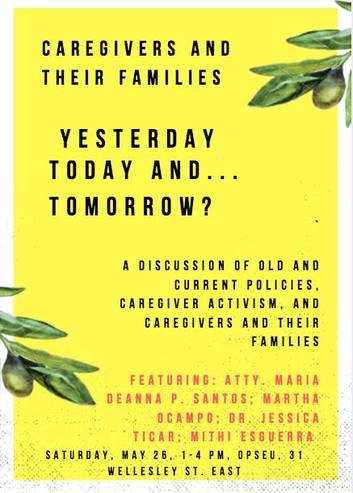
CAREGIVERS AT KANILANG MGA PAMILYA: NOON, NGAYON AT... BUKAS?
Isang talakayan at legal info session tungkol sa Caregiver Program

Sabado, ika-26 ng Mayo 2018
1:00-4:00 p.m.

OPSEU, 31 Wellesley St. East
(maaaring lakarin mula sa Wellesley station)

Sa mga nakaraang taon, maraming naging pagbabago sa Caregiver Program (dating Live-in Caregiver Program) ng Canada. Para sa maraming caregiver, nagiging sanhi ito ng kalituhan o kumplikasyon sa pagtatrabaho o pagsasaayos ng mga papel/status sa Canada. Kasabay pa nito, sa kabila ng mga pagbabago sa programa, patuloy ang mga problema kaugnay nito tulad ng pagkakahiwalay ng mga caregiver sa kanilang mga pamilya, at kawalan ng katiyakan sa kanilang kinabukasan.

Inaanyayahan ng GABRIELA-Ontario ang mga caregiver at iba pang kababayan nating nais matuto tungkol sa isyung ito sa isang talakayan. Magbabahagi ng impormasyon sina:

Mithi Esguerra - GABRIELA-Ontario
Martha Ocampo - Caregiver Connections Education and Support Organization
Dr. Jessica Ticar, PhD - Youth & Family Counsellor
at Atty. Maria Deanna P. Santos - Filipino-Canadian Immigration Lawyer

Para sa karagdagang impormasyon:
[email protected]


Read More

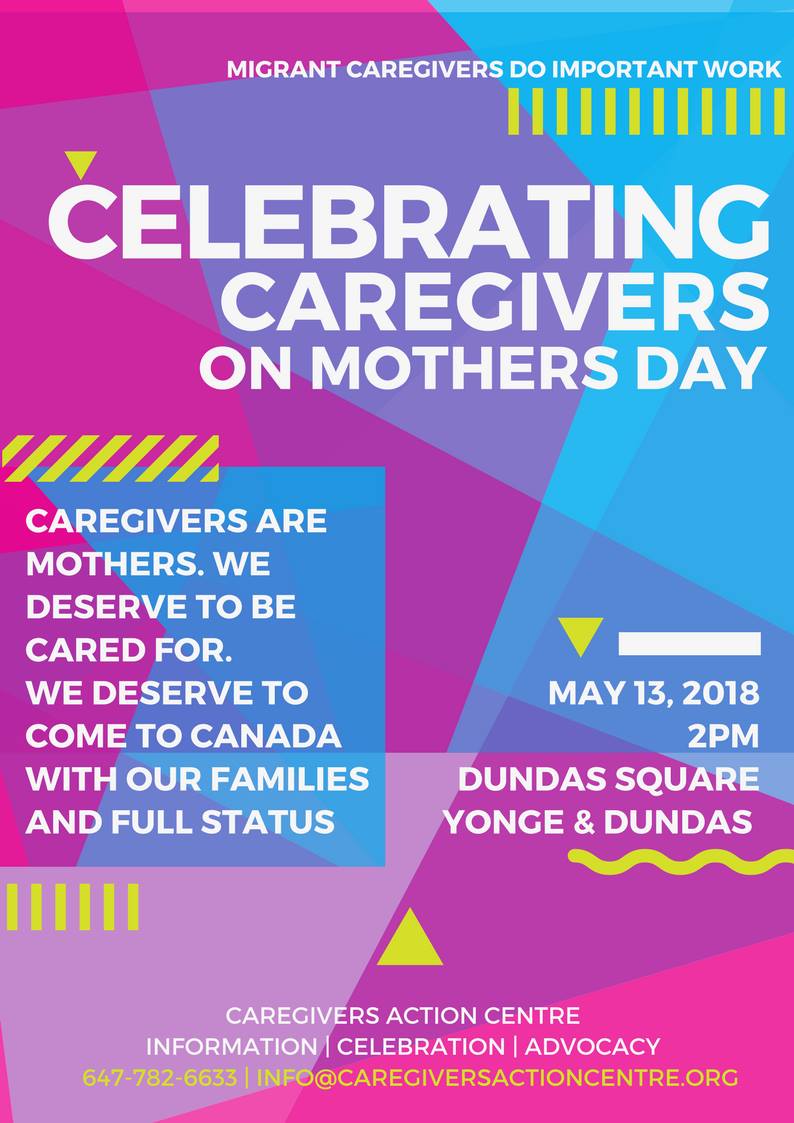
Celebrating Caregivers on Mother's Day

4/29/2018

 
Picture
Celebrating Caregivers on Mother's Day
Sunday May 13, 2018

2-5 PM
Yonge-Dundas Square

We, the migrant caregivers who come to take care of your children and elders, deserve to be cared for. We deserve to come to Canada with our families and permanent resident status. We do vital work that allows this society to function.


This Mother's Day, we are inviting all current and former live-in and live-out caregivers, and those who want to show us appreciation, to a celebration at Yonge-Dundas Square.

This event is co-hosted by Caregivers Action Centre (CAC) and Caregiver Connections Education and Support Organization (CCESO) and is part of a National Day of Action organized by CAC, CCESO, the Association for the Rights of Household Workers (Montreal), Filipino Canadian Advocacy Network, Filipino Workers Network of BC, GABRIELA-Ontario, Migrante Alberta, Migrante BC, Migrante Canada, Migrante Ontario, Migrant Workers Centre (Vancouver), Vancouver Committee for Domestic Workers' and Caregivers' Rights (CDWCR), and Victoria Filipino Canadian Association.
<<Previous
Forward>>

    Categories

    All
    Action
    Education
    Social
    Support

    Archives

    March 2025
    June 2024
    February 2024
    November 2023
    August 2023
    June 2023
    April 2023
    March 2023
    December 2022
    March 2022
    July 2021
    May 2021
    April 2021
    March 2021
    January 2021
    November 2020
    October 2020
    June 2020
    May 2020
    February 2020
    September 2019
    July 2019
    June 2019
    March 2019
    October 2018
    August 2018
    May 2018
    April 2018
    July 2017
    June 2017

Proudly powered by Weebly
  • Home
  • Careworker's Manual
  • Updates
  • Activities
  • COVID-19
  • RESOURCES
  • NEWSLETTER